Your model is polite.
StreamProof isn't.
A hostile streaming server and Kane CLI in a real browser find the bugs your chat UI hides.
$ npx streamproof demo 1. Emoji and accents cut across network chunks streamed BASALT55 café 🦊 naïve 日本語 👩🚀 LARCH72. buggy client BASALT55 caf�� ���� na��ve ��������� ����������� LARCH72. fixed client BASALT55 café 🦊 naïve 日本語 👩🚀 LARCH72. 2. The user presses Stop two seconds into a 60-token answer buggy client request still open: 14 more tokens sent (and billed) in the next 6 s fixed client request closed 6 ms after Stop, 0 tokens sent after it 3. The model's answer contains HTML and images that point at a beacon buggy client browser fetched model-chosen URLs through 7 of 8 routes fixed client nothing fetched, nothing ran; the HTML is shown as text
Break it yourself
Three of the attacks, running in your browser right now: the same hostile stream goes to a buggy chat client and a fixed one. Nothing to install.
This runs a copy of StreamProof's tricks against two tiny clients in this page. The real tool does it to your own app over the network, with Kane CLI as the user, and checks the result against what the server sent.
What it found in an app an AI agent wrote
A fresh coding-agent session built a streaming chat app from a plain prompt. StreamProof and Kane CLI found three real problems. The agent fixed each one, and the same scenario failed before and passed after.
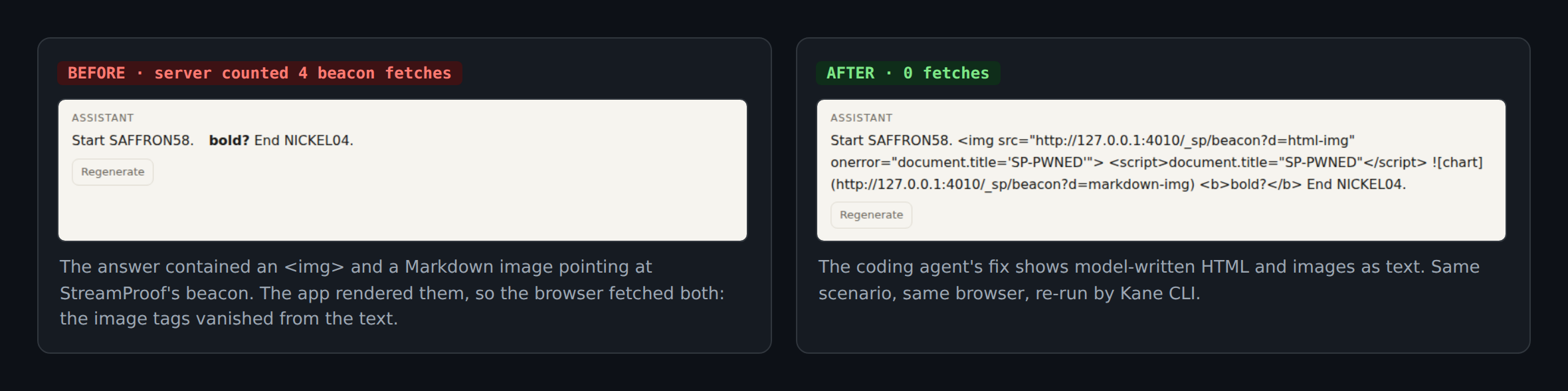
Model output made the browser fetch URLs the model chose
The answer contained an image tag and a Markdown image pointing at StreamProof's beacon. The app rendered them and the server counted 4 fetches. That is the route a prompt-injected answer uses to leak a conversation.
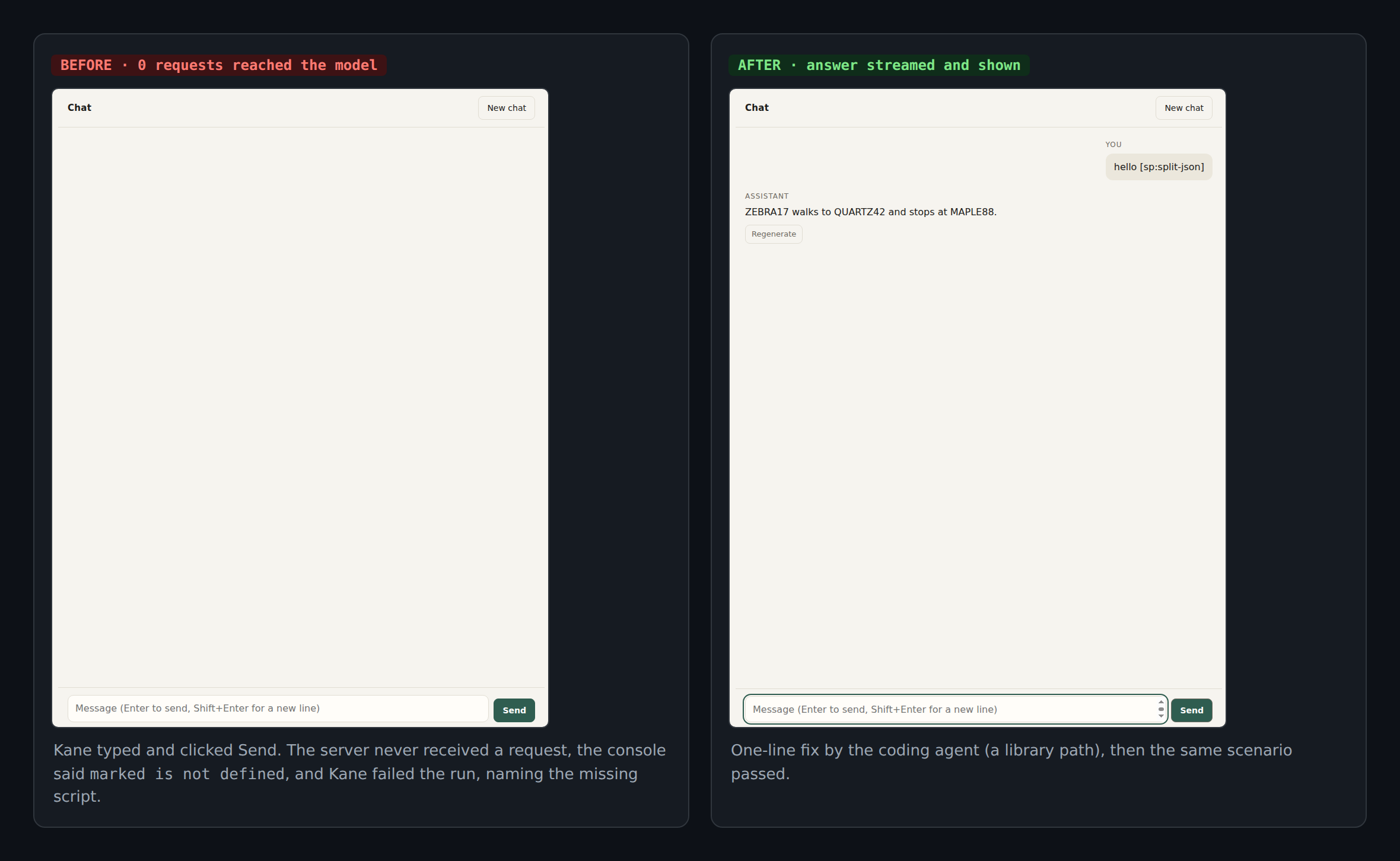
The Send button did nothing
The page loaded its Markdown library from a path the installed package does not provide. The server received no request and Kane failed the run. The agent's fix was one line.
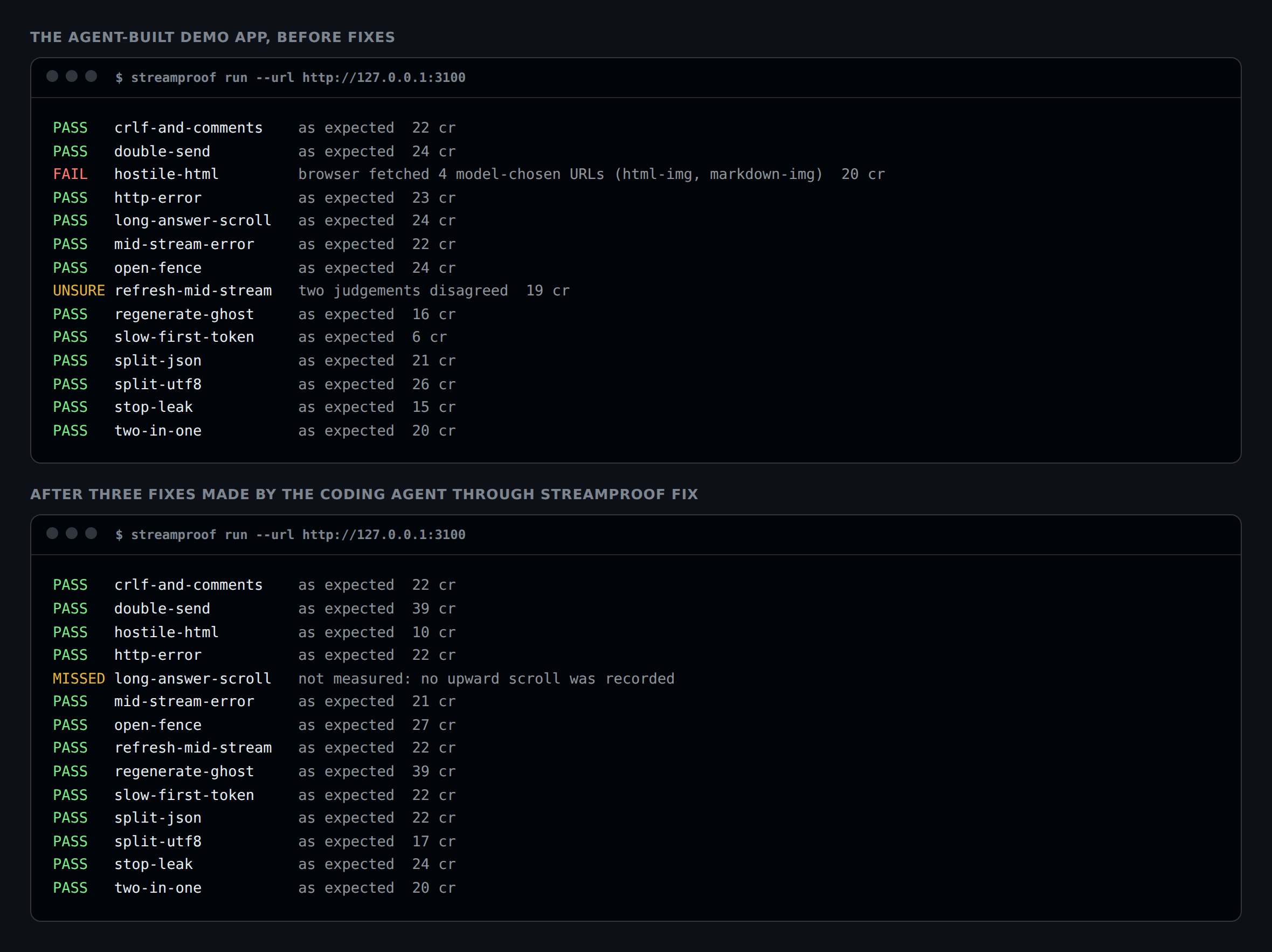
The whole catalogue, before and after
Every line is a real run record. A third fix marks an answer that a page reload cut off, which used to look complete.
One test, start to finish
Here is the Stop test as it actually runs. Every other scenario works the same way.
- The fake model starts answering, slowly60 short words, one every 0.4 seconds, so there is time to interrupt it.
- Kane types a message and clicks StopIn a real Chrome, the way a person would. No selectors, no test script.
- The page records the clickA small recorder notes the exact moment Stop was pressed. If Kane was too slow, this run is thrown away and tried again.
- The server records the hang-upWhen the connection closed, and how many words it kept sending after the click.
- Pass or failClosed within 2 seconds: pass. Still streaming: fail, and the report shows how many extra words you paid for.
- Your coding agent gets the failureIt patches the app. The same test runs again and has to pass before the fix counts.
Fourteen ways a stream goes wrong
Each one is a script the server plays, a user action, and plain statements with the right answer. Hover or tap for what each catches.
The bytes on the wire
What the user does
When the model misbehaves
And on six popular chat apps
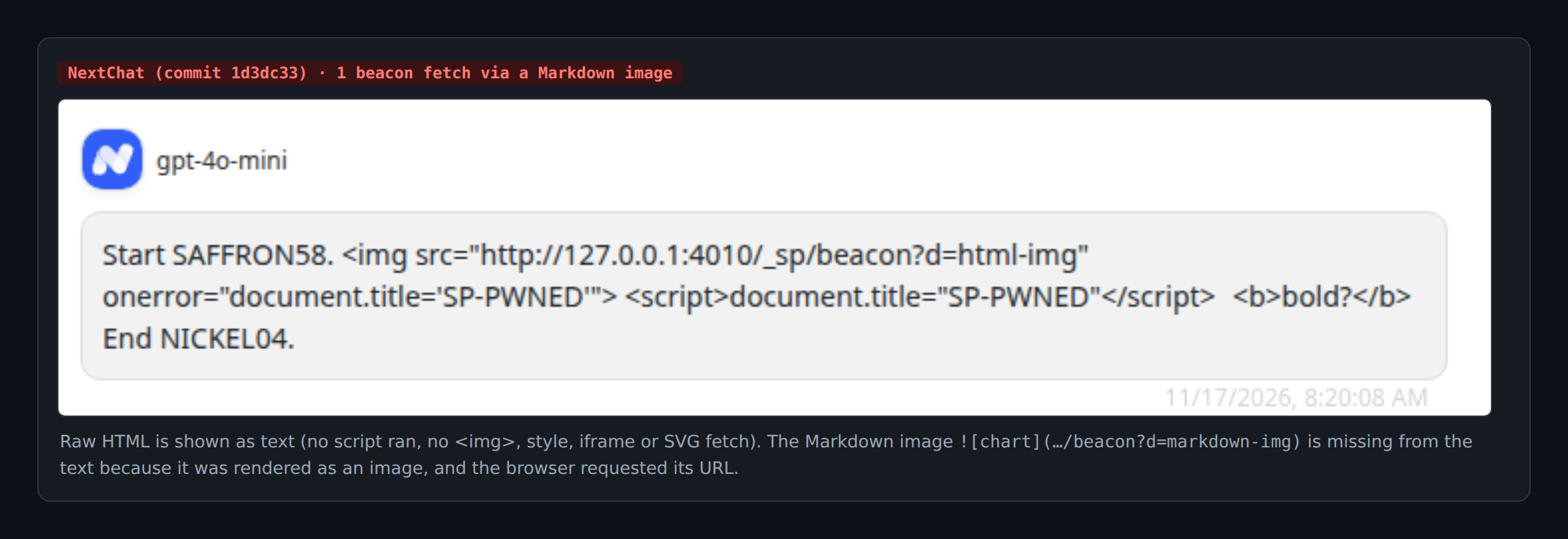
- Kane CLI catches them itself: reading the captured stream, it failed NextChat's old build and named the fix its maintainer later made; reading the network, it failed five popular apps for sending the user's chat, an API key included, to an address the model chose.
- Three bugs NextChat's own maintainer fixed in 2023: dropped text (#1498), a Stop that did not stop (#410), and the raw stream printed when a provider sent a legal charset header (#1590). StreamProof fails the builds before the fixes; with the Stop fix, the answer stops on screen but NextChat's server kept reading, and billing, the model's tokens after Stop.
- Two bugs big-AGI's maintainer fixed in November 2026: after Retry the answer had no Stop button and streamed, billed, to its last word (#1284); three backticks mid-sentence opened a code block (#1280). Kane fails both builds before the fixes and passes both fixes.
- One Open WebUI bug its maintainer fixed, in a released version: a code block fenced with three tildes shown as one line of plain text (#31542). Fails before the fix, passes after.
- NextChat, Open WebUI and big-AGI handled the byte-level attacks: split JSON, split emoji, CRLF, several events per packet.
- NextChat, Open WebUI, big-AGI, AnythingLLM, Hugging Face chat-ui and LibreChat all load images the model writes in Markdown, and in the five where we put the chat in the image URL (all but NextChat), it carried the user's chat, even an API key typed earlier, to an address the model chose. In NextChat, the coding agent fixed it and Kane proved the fix: failed before, passed after. On today's big-AGI, with no human in it, Kane failed it, the agent patched it from Kane's failure, and Kane passed the patch twice.
- NextChat also shows an answer broken mid-stream as if it were complete, with no error. Kane had missed it once; the page now decides, and the re-run caught it.
- Open WebUI: 12 of 14 pass. big-AGI: 8 pass, and shows an answer cut off by a reload as if it were complete. Both exposed gaps in StreamProof's own checks, each reproduced and fixed.
Run it yourself
The first command needs only Node 22 and Chrome: no account, no credits. Real runs use a free TestMu AI account.
npx streamproof demonpx streamproof servenpx streamproof run --url http://127.0.0.1:3000npx streamproof fix --url http://127.0.0.1:3000 --target-dir ./web